

A challenge to cold and warm dark matter
John McKean
Recently, from extremely high angular resolution imaging of the gravitational lens system JVAS B1938+666 with the EVN at 1.7 GHz (McKean et al. 2025), a one million solar mass dark object was discovered (Powell et al. 2025; Nature Astronomy). Although the probability of finding such an object in the EVN dataset is consistent with the cold dark matter model, a new analysis on the structure of the dark object has presented some challenges. Due to the excellent data quality provided by the EVN, Vegetti et al. (2026; Nature Astronomy) were able to test 23 different models for the mass-density profile of the dark object, which included a black hole, and also a globular cluster, a dark matter halo, and an ultra-compact dwarf galaxy, all with and without a central massive black hole (see inset of Figure 1). Vegetti et al. found that mass of the object was too concentrated to be explained by a dark matter halo from either a cold or warm model, which presents a significant challenge to these generally accepted theories for dark matter. Instead, the result potentially points to a more exotic form, where the dark matter self-interacts. The best fitting model was found to be an extended disk of dark matter that surrounds a massive black hole. New observations with the EVN have recently been taken that its hoped will shed further light on the origin of the dark object.
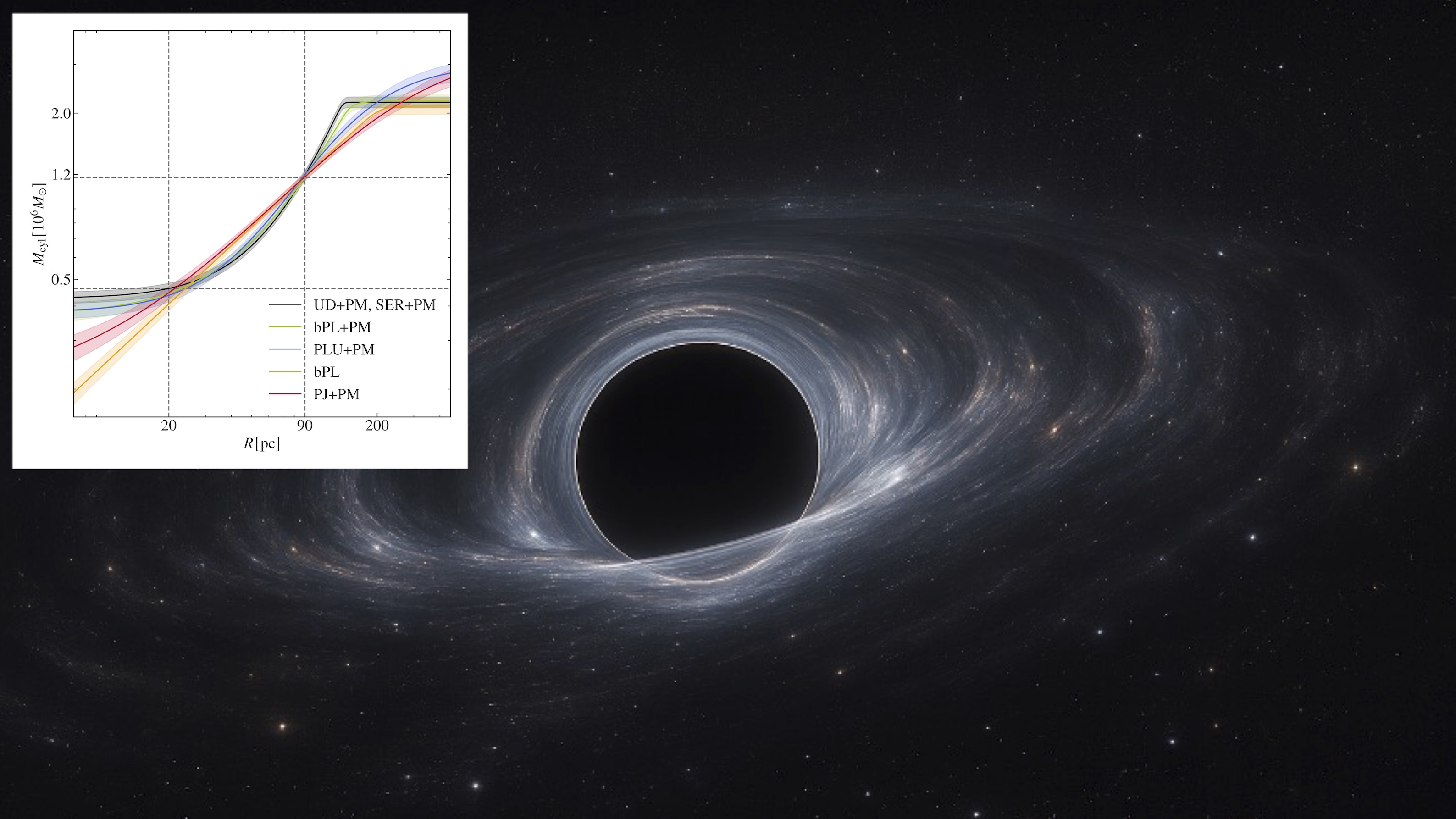
Figure: A generated representation of what the dark object could be. The best fitting model is a massive black hole (~0.3 million solar masses) that is embedded in an extended disk of dark matter with a size of about 140 parsecs. The mass profile of the object is shown as the black curve of the inset. Also shown are the results from other mass profiles tested with the EVN data, which include models that describe a globular cluster, a dark matter halo and a dwarf galaxy. Image credit: Simona Vegetti.
Link to the papers:
McKean et al. (2025) https://doi.org/10.1093/mnrasl/slaf039
Powell et al. (2025) https://www.nature.com/articles/s41550-025-02651-2
Vegetti et al. (2026) https://www.nature.com/articles/s41550-025-02746-w
Contact:
John McKean, University of Groningen, University of Pretoria, South African Radio Astronomy Observatory. Email: john.mckean@up.ac.za